Yong Jae Lee
Published: October 30, 2026 · Reviewed: October 2026 · 7 min read
Researched and written by Yong Jae Lee · Content follows Australian Dietary Guidelines
What NSW Health's choking guidance for early childhood services says not to serve, how to make other foods safer, and how that maps onto a kindy lunchbox.
Why Under-5s Need Different Food
Young children choke on food more easily than older children. Their ability to chew and swallow is still developing, and it varies a lot from child to child. Some foods are riskier because of their size, how hard they are, or their shape.
NSW Health's Helping to prevent children from choking is part of the NSW Menu Planning Guide, written for early childhood education and care services. It names foods not to serve, says how to prepare others so they are safer, and covers how children should eat. The page was current as at 24 August 2026.
This guide puts the food part of that page in plain English and shows where it touches the menus and snacks in our planner. It is a summary, not a replacement. The original page is short and worth reading in full.
Under 3 or Under 5?
NSW Health's list of high-risk foods is for children under 3. The planner's option is called Kindy (under 5), and we apply the same list to every child under 5. That is our own call, not something NSW Health says.
Our reason is simple. A kindy lunchbox can be for a two-year-old in long day care or a four-year-old in preschool, and the planner can't tell them apart. We would rather leave a few foods out of a four-year-old's box than pack them for a two-year-old.
There is no national list to fall back on. The national regulations for early childhood services ask each service to have a policy on nutrition, food and drinks, but they don't list choking foods. If your service has its own food rules, those come first.
Foods to Leave Out
The guidance lists ten kinds of high-risk food. Six of them come with no way to make them safer, so the planner's Kindy option leaves them out. The right-hand column is where each one turns up in our data:
| The guidance says not to serve | Where it appears in our menus and snacks |
|---|---|
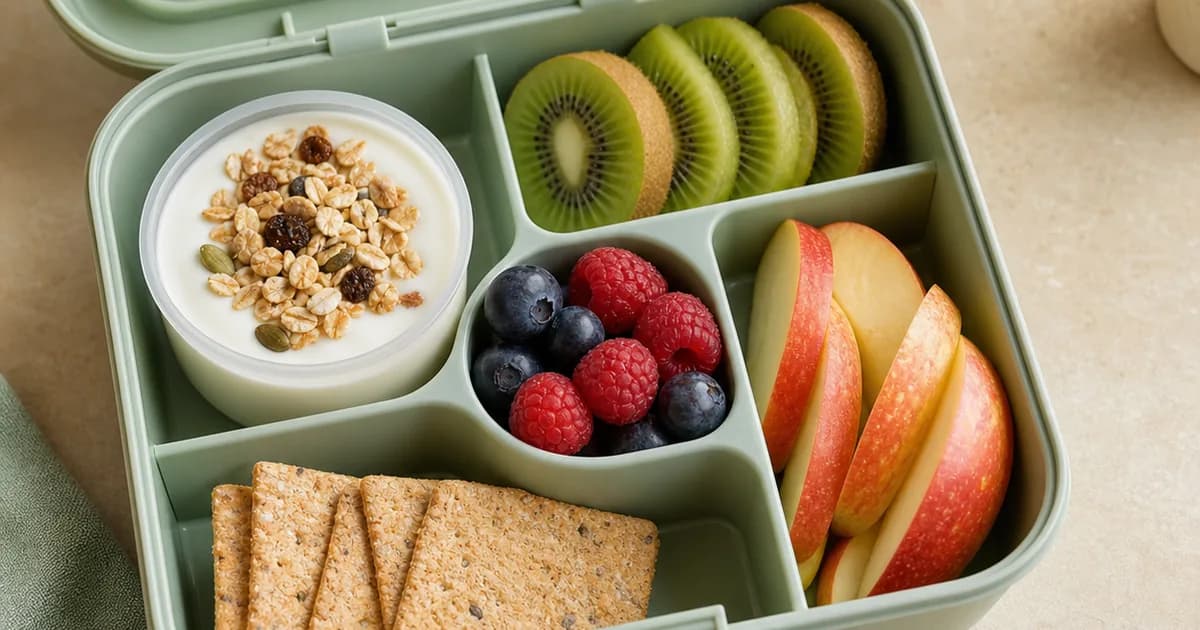
| Whole nuts and seeds | Mains: Yoghurt & Muesli |
| Popcorn and corn chips | Snacks: Popcorn; mains: Nachos (corn chips) |
| Sultanas and raisins | Treats the planner never packs: Sultanas |
| Hard biscuits and crackers | Snacks: Rice Crackers, Rice Wheels and Wholegrain Crackers; mains: Veggie Sticks & Hummus Box (gf crackers), Apple & Cheese Box (crackers) and DIY Snack Box (crackers) |
| Hard, jelly and button-shaped lollies | Nothing in our menus or snacks |
| Chewy, sticky foods such as fruit straps, fruit bars and marshmallows | Treats the planner never packs: Fruit Leather |
The other four lines on the list are about the form a food is in — raw, whole, with skin, or in large pieces. The guidance's own table says how to make those foods safer, so the planner keeps them and adds a prep note instead:
- Raw, hard vegetables and fruit — see "hard foods" below
- Grapes and whole peas — see "round and slippery foods" below
- Fish and other animal foods with skin or bones — see "foods with skins, strings or bones" below
- Large pieces of meat, and sausage skins — see "foods with skins, strings or bones" below
Two extras that are our call, not the guidance's
- Roasted Chickpeas — our own call, not on the guidance's list — small and hard like nuts, and not practical to alter.
- Veggie Straws — our own call, not on the guidance's list — it names corn chips, and veggie straws are the same kind of crisp snack.
That is our own judgement, not something NSW Health says. Cooked chickpeas inside a main are soft, so those mains stay in, with the guidance's note to cut or squash into small pieces: Vegetable Curry and Chickpea Salad Sandwich.
Foods to Change Before Serving
These are the foods in our menus and snacks that the guidance's "how to make foods safer" table covers, with the same wording the planner shows on each day:
| Type of food (the guidance's heading) | In our menus and snacks | How to make it safer |
|---|---|---|
| Hard foods | Carrot, Celery and Sugar Snap Peas | Steam until soft, or grate or slice thinly. |
| Hard foods | Apple and Pear | Grate it, or cut it into thin slices. |
| Hard foods | Dried Apricots and Dates | Cut into very small pieces. |
| Hard foods | Peanut Butter | Use a smooth spread, not crunchy. |
| Foods with skins, strings or bones | Peas, Corn, Sweetcorn and Edamame | Cook, then finely mash or squash. |
| Foods with skins, strings or bones | Sugar Snap Peas | Remove the strings. |
| Foods with skins, strings or bones | Chicken, Chicken Breast, Chicken Thigh and Cooked Chicken | Remove the skin and gristle. |
| Foods with skins, strings or bones | Smoked Salmon | Remove all bones, including small ones. |
| Foods with skins, strings or bones | Chicken, Chicken Breast, Chicken Thigh, Cooked Chicken, Ham, Beef, Roast Beef, Turkey, Salami, Pork Shoulder, Bacon, Ham/Bacon, Meatballs, Beef Patty, Chicken Skewers, Chicken/Tofu and Tuna/Chicken/Avocado | Cut or tear into small pieces. |
| Foods with skins, strings or bones | Cocktail Sausages and GF Sausages | Remove the skin, then cut into small pieces. |
| Foods with skins, strings or bones | Olives and Watermelon | Remove tough seeds, stones or skin. |
| Round and slippery foods | Grapes, Blueberries, Berries, Cherry Tomatoes, Chickpeas and Olives | Cut or squash into small pieces. |
What we don't flag
We only put a note on foods the guidance names. Strawberries, sliced tomato, lettuce, cucumber, capsicum, cheese, boiled egg, pretzels and breadsticks get no note from us — not because they are risk-free, but because the guidance doesn't list them and we won't claim a risk it doesn't state. Supervision still matters for every food.
Eating Safely: The Rest of the Guidance
Food is only part of the page. It also asks services to:
- Ask families how well their child can chew and swallow.
- Make sure children sit down for meals and snacks.
- Have an educator with a current first aid certificate watching children while they eat and drink.
It also explains that gagging and spitting food out is normal while children learn to eat, and lists the signs of choking. For first aid itself, follow the original page and your service's first aid procedures.
Using the Planner's Kindy Option
Tick Kindy (under 5) under Allergies / Restrictions before you generate a plan. With it on:
- Excluded foods are left out. That takes 5 of our 94 mains (Yoghurt & Muesli, Veggie Sticks & Hummus Box, Nachos, Apple & Cheese Box and DIY Snack Box) and 6 of the 33 snacks the planner packs (Rice Crackers, Roasted Chickpeas, Rice Wheels, Popcorn, Veggie Straws and Wholegrain Crackers) out of the running. The planner never packs treats, so sultanas and fruit leather don't come up either way.
- Each day lists prep notes for anything in the "change before serving" table, on the day card and in the recipe window.
- It combines with the other filters, so a kindy plan can also be nut-free, vegetarian and so on.
- Portions get smaller. Ticking Kindy also sets the planner's Portion size to Under 5 / Kindy (ages 3–4): about ×0.76 of the standard serve, which is sized for primary school children aged 5–12. The ratio is an estimate from average daily energy needs by age in the Nutrient Reference Values for Australia and New Zealand, not a prescription — you can change it.
The snack checker shows the same Kindy line for every snack the planner packs.
Try the Aussie Lunchbox Planner →
Source and Licence
This page summarises, in our own words, Helping to prevent children from choking (NSW Ministry of Health, NSW Menu Planning Guide, current as at 24 August 2026). NSW Health's website copyright notice licenses its web material under Creative Commons Attribution 4.0; attribution: © State of New South Wales NSW Ministry of Health. For current information go to www.health.nsw.gov.au.
We have reorganised it around the menus and snacks in our planner, applied its under-3 list to children under 5, and added two judgements of our own (roasted chickpeas and veggie straws). All three are marked as ours above. NSW Health has not reviewed or endorsed this page or the planner.
References & Sources
About this article
This article was researched and written by Yong Jae Lee, a parent based in Auckland, New Zealand, who runs Aussie Lunchbox and its sister site Kiwi Lunchbox as a solo project. I am not a dietitian or a health professional, so nothing here is medical advice. Where an article rests on desk research rather than something I have cooked or used myself, it says so, and nutrition writing is aligned with Australia's healthy eating guidelines. If you spot an error or have a suggestion, please contact us.